

What Are AI-Powered Focus Groups?
An AI-powered focus group is a market research method where artificial intelligence handles moderation, analysis, or participant simulation — either facilitating real-participant discussions or generating synthetic personas to predict consumer responses. AI-powered focus groups cost 60–80% less than traditional sessions, deliver findings in 24–48 hours, and eliminate the four structural biases — groupthink, moderator influence, social desirability, and dominant-voice distortion — that reduce traditional research quality. A complete three-phase AI research program costs $8,000–$15,000 versus $45,000–$85,000 for a traditional equivalent, with first-project ROI typically exceeding $22,000.
Introduction
The $140 billion global market research industry is being restructured by artificial intelligence faster than most research teams are adapting to it. 72% of insights professionals are now using or evaluating generative AI, up from just 20% in 2022 — the steepest tooling adoption curve the industry has ever recorded. Yet most teams are adopting AI incrementally; adding transcription tools here, sentiment analysis there, without building the integrated capability that produces the full ROI the technology makes possible.
This guide covers everything a US marketing or research team needs to understand, evaluate, and implement AI-powered focus groups in 2026. It is organized as a complete reference; from foundational definitions through advanced research program design, so you can navigate to the section most relevant to your current situation and return to the others as your program matures. H-in-Q’s AI market research team built this guide from direct implementation experience across US and MENA markets, synthesizing the most current industry evidence on accuracy, cost, methodology, and ROI. Every claim is sourced. Every recommendation is actionable.
Section 1: What AI-Powered Focus Groups Are and Why They Matter Now
An AI-powered focus group is a market research method where artificial intelligence handles moderation, analysis, or audience simulation; either by facilitating discussions with real participants or generating synthetic personas to predict consumer responses. The method delivers qualitative insights in 24–48 hours at 60–80% lower cost than traditional focus groups and eliminates the four structural biases that systematically reduce traditional research data quality.
The “why now” question has a clear answer: three forces converged in 2024–2025 to move AI focus groups from experimental to operational.
Force 1: Capability threshold crossed. Large language models reached sufficient behavioral fidelity to produce reliable synthetic consumer research for the first time. Platforms buhivoxilt on this foundation can now generate personas that produce directionally accurate responses for the majority of standard research use cases.
Force 2: Cost economics inverted. A focus group study that cost $45,000–$85,000 using traditional methods can now be approximated at $8,000–$15,000 using AI hybrid approaches; a 60–83% reduction that makes continuous research economically viable for mid-market US businesses for the first time.
Force 3: Competitive urgency. 84% of researchers now believe research agents will oversee more than half of all research projects within five years. The teams building AI research capabilities now are establishing a compounding insight advantage over competitors who are still running quarterly traditional studies.
The core insight that frames everything in this guide: AI-powered focus groups are not a cheaper, faster version of traditional focus groups. They are a structurally different research architecture — one that changes the economics, cadence, bias profile, and competitive dynamics of consumer insight for every US organization that adopts it properly.
Section 2: The Three Models — Which Type of AI Focus Group Do You Actually Need?
The single most consequential decision in AI focus group adoption is not platform selection; it is category selection. The market has divided into three fundamentally different methodologies, each with different costs, accuracy profiles, and appropriate use cases. Choosing the wrong category for your research objective produces unreliable data regardless of which platform you use within that category.
Model 1: AI-Assisted Focus Groups (Real Participants + AI Infrastructure)
This model keeps authentic human participants at the center. AI handles everything around them: recruitment targeting, real-time moderation support, transcription, sentiment analysis, and automated thematic coding. The human experience and group dynamic of a traditional focus group is preserved; the logistical and analytical burden is eliminated.
Best for: Concept validation that will inform significant investment decisions, research on emotionally complex or sensitive topics, studies requiring authentic group dynamic observation, multilingual research across multiple US audience segments.
Cost range: $2,000–$8,000 per study. Timeline: 9–14 days total.
Leading platforms: HiVox-in-Q (community-based, multilingual), Remesh (large-scale live engagement up to 1,000 participants), Discuss.io (end-to-end video focus groups with global recruitment). 👉 See the full platform comparison
Model 2: Synthetic Persona Platforms (AI-Generated Audience Simulation)
This model replaces real participants entirely with AI-generated personas built from behavioral and demographic data. The system generates detailed audience representations, presents them with your research stimulus, and produces both qualitative reactions and quantitative preference rankings; all without recruiting a single real person.
Best for: Rapid hypothesis screening, concept ranking before investing in real-participant validation, pre-testing discussion guides, multi-variant creative testing, budget-constrained research programs.
Cost range: $100–$500 per study. Timeline: 3–6 hours.
Accuracy ceiling: 85–92% correlation with real-participant findings for directional research. Not suitable as sole basis for high-stakes final decisions.
Leading platforms: Dytto, Sampl, Synthetic Users, POPJAM.
Model 3: AI Analysis Tools (Process Existing Session Recordings)
This model does not run focus groups; it makes analyzing them dramatically faster. Upload any focus group recording from any platform, and AI delivers speaker-labeled transcripts, automated thematic clustering, sentiment scoring, and synthesized findings in hours rather than weeks.
Best for: Teams with existing research programs who need faster analysis, research organizations processing high volumes of qualitative data, teams that want AI analytical benefits without changing their session methodology.
Cost range: $30–$200/month (individual), $15,000+/year (enterprise). Timeline: 2–6 hours per session analyzed.
Leading platforms: Looppanel, BTInsights, Insight7.
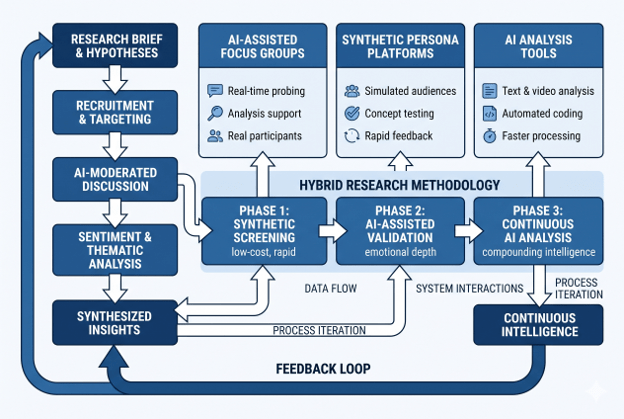
The Hybrid Research Stack: How Sophisticated Programs Use All Three
The research programs producing the strongest results in 2026 are not choosing between these models — they are sequencing them strategically:
Phase 1 — Synthetic screening: Test 5–10 hypotheses simultaneously with AI personas. Cost: $500–$1,500. Timeline: 1 day. Eliminate weak hypotheses before spending on real participants.
Phase 2 — AI-assisted validation: Test the 2–3 strongest candidates from Phase 1 with real participants on an AI community platform. Cost: $4,000–$8,000. Timeline: 5–7 days. Generate authentic qualitative depth and segment-level findings.
Phase 3 — AI analysis: Run automated thematic coding and sentiment analysis on Phase 2 sessions. Cost: included in platform or $0–$200 additional. Timeline: 12–24 hours. Compress the gap between session close and actionable findings to under 24 hours.
Total hybrid program cost: $8,000–$15,000. Total timeline: 9–14 days. Equivalent traditional program: $45,000–$85,000 over 6–8 weeks.
Section 3: How AI-Powered Focus Groups Work — The Complete Process
Understanding the mechanics behind each model is essential for building realistic expectations about what technology can and cannot do. The following is a component-level breakdown of each AI system in the research workflow.
AI Recruitment and Participant Targeting
AI recruitment tools allow research teams to specify demographic attributes, psychographic profiles, and behavioral qualifiers simultaneously and match participants from panels of millions in hours rather than days. The targeting algorithms identify participants not just by demographics but by behavioral signals: recent category purchase, competitor brand usage, specific life events, professional role and seniority. This behavioral targeting produces more contextually relevant participant pools than traditional screener-based recruitment.
For community AI platforms like HiVox-in-Q, the recruitment infrastructure is built into the platform; targeting, scheduling, reminders, and no-show management run automatically without manual research team involvement.
AI Moderation: How It Actually Works
AI moderation in real-participant sessions operates through a combination of NLP analysis of participant responses and dynamic question management. The system does four things simultaneously: ensures all participants contribute (preventing dominant-voice distortion), probes vague or incomplete responses with targeted follow-up questions, adapts the pacing of the discussion based on participant engagement signals, and flags high-value responses for researcher attention in real time.
The critical differentiator between AI moderators is probing depth. The highest-quality AI moderation platforms do not accept surface-level responses; they apply at least two follow-up turns on substantive questions where the initial answer lacks specificity. When evaluating platforms, ask for sample transcripts and count the probing turns. Platforms that accept the first response are collecting the same data a survey would collect; the value of qualitative research lies in what happens after “I don’t know” or “it’s fine.”
AI Sentiment Analysis and Real-Time Tagging
Modern AI analysis systems detect sentiment across seven dimensions in 2026: positive/negative valence, emotional intensity, sarcasm detection, urgency signaling, hedging language, brand fatigue markers, and unexpected enthusiasm. Each dimension is tagged per response per participant, producing a multi-dimensional emotional map of the session that manual coding could never replicate at equivalent scale and consistency.
Real-time sentiment tagging means researchers monitoring a live session can see emotional response patterns forming as the session runs; enabling dynamic probing of the most commercially significant moments while the context is still fresh.
Automated Thematic Coding and Synthesis
Post-session AI analysis uses semantic clustering to group responses by theme across all participants simultaneously. The system identifies which themes appear most frequently, which are most emotionally charged, and which correlate with the highest-intent participant profiles. It then generates a synthesized findings report that links every insight to the specific participant quotes that support it; addressing the hallucination risk that plagues AI analysis tools that generate insights without source attribution.
Organizations using AI-powered qualitative research typically see a 60–80% reduction in analysis time. For a team that previously spent 80–120 hours manually coding a 3-session focus group program, AI analysis compresses that to 12–28 hours of human review; while producing more consistent and more comprehensive thematic coverage.
Section 4: AI vs. Traditional Focus Groups — The Honest Comparison
This topic is covered in detail in our dedicated AI vs. traditional focus groups comparison guide.
The summary for this guide:
| Dimension | Traditional | AI-Assisted | Synthetic |
|---|---|---|---|
| Cost per study | $7,000–$30,000 | $2,000–$8,000 | $100–$500 |
| Timeline | 4–8 weeks | 1–2 weeks | Hours |
| Groupthink risk | High | Low | Eliminated |
| Moderator bias | High | Eliminated | Eliminated |
| Emotional authenticity | Highest | High | Moderate |
| Geographic reach | Limited | Global | Global |
| Iterative testing | 1×/quarter | Weekly | Daily |
| Physical product research | ✅ | ❌ | ❌ |
When traditional still wins: Physical product interaction, social influence dynamic observation, high-stakes stakeholder alignment sessions, genuinely unprecedented product categories with no historical behavioral data. For every other common research objective, AI delivers equivalent or superior quality at a dramatically lower cost and time.
Section 5: Accuracy, Bias, and Validation
The Accuracy Evidence
Studies comparing AI focus group outputs to traditional focus group findings show 85–92% correlation for concept testing, messaging evaluation, and directional research. This correlation is strong enough for the majority of commercial research decisions and stronger than the consistency traditional focus groups typically achieve across multiple sessions, given the variability introduced by different moderators, different participant recruitment batches, and different group dynamics.
AI focus groups are more consistent, not just faster. The same AI moderation standard applied to every participant in every session produces data that is directly comparable across time periods, geographies, and audience segments; something traditional research cannot guarantee.
The Bias Profile: What AI Eliminates and What It Introduces
Biases AI eliminates by design:
- Groupthink: every participant contributes independently before group dynamics influence responses
- Moderator influence: consistent probing standard applied to every participant without human variability
- Social desirability bias: 83% of participants report greater openness with AI interviewers than human moderators
- Dominant-voice distortion: AI ensures equal contribution depth across all participants regardless of communication style
Biases AI introduces:
- Algorithmic bias from unrepresentative training data; most significant for synthetic personas built on historical behavioral datasets that underrepresent specific demographic groups
- Sycophancy bias in LLM-simulated personas; a 2024 Stanford HAI study found LLM personas exhibit convergence toward majority opinions at rates that diverge from real survey respondents
- Recency bias; AI personas reflect the behavioral patterns in their training data, which may not capture recent market shifts
The validation protocol that eliminates most AI bias risk: Require quote-level attribution for every synthesized insight. Review raw transcript excerpts for the 5 highest-stakes findings before acting on them. Cross-reference key findings against at least one other data source. Human-in-the-loop validation adds hours to the timeline and zero cost; it is the non-negotiable safeguard for any AI research program.
Section 6: Cost, Timeline, and ROI — The Full Financial Picture
Complete Cost Breakdown by Program Type
Entry-level AI research program (one synthetic screening + one AI-assisted session):
- Phase 1 synthetic screening: $500–$1,500
- Phase 2 real-participant AI session (20–30 participants): $3,000–$6,000
- AI analysis: included in platform or $0–$200
- Total: $4,000–$8,000
Standard AI research program (full three-phase hybrid):
- Phase 1 synthetic screening: $800–$1,500
- Phase 2 two AI-assisted sessions (40–60 total participants): $6,000–$12,000
- Phase 3 AI analysis: included or $200–$500
- Total: $8,000–$15,000
Enterprise AI research program (continuous quarterly program):
- Platform subscription: $15,000–$50,000/year
- Per-study costs: $2,000–$5,000
- Annual research volume: 12–24 studies
- Total annual cost: $39,000–$170,000
Traditional equivalent for comparison:
- Single 3-session traditional program: $45,000–$85,000
- Annual traditional research program (4 programs/year): $180,000–$340,000
ROI Calculation Framework
A sample first-project ROI calculation: 50 hours saved at $150/hour researcher rate equals $7,500 in internal time value. Add avoided external vendor costs of $15,000 for a typical traditional focus group study. Total first-project ROI: $22,500.
For organizations running 4+ research programs per year, the annual ROI of switching to AI hybrid methodology is typically $100,000–$250,000 in combined vendor cost savings and researcher time reallocation; without any reduction in research quality or output volume.
The compounding ROI factor most calculations miss: AI research economics make continuous research viable. A team that runs 12 AI studies per year instead of 4 traditional studies generates 3x the consumer intelligence with comparable or lower total spend. The competitive value of that intelligence differential compounds over time in ways that are difficult to quantify but straightforward to observe in product launch performance, messaging conversion rates, and positioning accuracy.
Section 7: How to Choose the Right AI Focus Group Platform
Platform selection follows category selection. The seven questions below apply within the AI-assisted real-participant category; the most consequential category for organizations making significant research decisions.
Question 1: Does the AI Probe Vague Answers, or Accept the First Response?
Ask for a sample transcript and count the follow-up turns on substantive questions. The minimum standard is two follow-up turns per respondent on questions where the initial answer is incomplete or unclear. Platforms that accept surface responses produce survey-grade data, not qualitative-grade data.
Question 2: Can It Run Your Target Scale Without Quality Degradation?
Pilot at your intended scale before committing to an annual contract. Some platforms degrade response depth when running 100+ simultaneous conversations. The quality of the 100th conversation should be indistinguishable from the quality of the 10th.
Question 3: Does It Support Your Audience Languages Natively?
If you research Hispanic-American, Francophone, or MENA audiences, native multilingual support is non-negotiable. Machine translation layered on English infrastructure loses cultural nuance and natural language patterns; the exact data that makes qualitative research valuable. HiVox-in-Q supports native language sessions.
Question 4: Does the Synthesis Output Include Quote-Level Source Attribution?
Every AI-generated finding must link back to the specific participant response that supports it. Platforms that produce synthesized insights without source attribution cannot be validated; and unvalidated AI insights are a liability, not an asset.
Question 5: What Is the Actual Pricing Model at Your Research Volume?
Per-respondent pricing punishes scale. Per-seat pricing limits democratization. Project-based pricing is the most transparent model for variable research volumes. Get total annual cost projections in writing before committing.
Question 6: What Compliance Certifications Does the Platform Hold?
Minimum standard for US enterprise research: SOC 2 Type II, GDPR compliance documentation, AES-256 data encryption, and explicit terms around whether participant data is used to train the platform’s AI models.
Question 7: Can You Pilot Before Committing Annually?
The right platform will allow a paid pilot study before requiring annual contract commitment. Platforms that require annual contracts before a pilot are not confident in their product quality. Run one study. Review the output quality. Then decide.
Section 8: Industry Applications — How US Sectors Are Using AI Focus Groups
Consumer Packaged Goods (CPG)
CPG is the category where AI focus group adoption is most advanced. The research objectives; concept testing, packaging validation, messaging evaluation, pricing sensitivity; map precisely to AI focus group strengths. A three-phase hybrid program (synthetic screening → AI-assisted validation → AI analysis) covers all standard pre-launch research needs at 60–80% lower cost than traditional programs, enabling CPG brands to run full research programs on product launches that previously launched with insufficient research evidence due to budget constraints. 👉 Read the full CPG AI focus group case study
SaaS and Technology
SaaS research teams use AI focus groups primarily for positioning validation, feature prioritization research, and competitive messaging testing. The asynchronous format of community AI platforms is particularly well-suited to busy B2B professional audiences; participants engage on their own schedule without sacrificing session quality. AI moderation handles the technical vocabulary and context-specific probing that makes B2B qualitative research difficult to moderate well at scale.
Retail and E-Commerce
Retail and e-commerce brands use AI focus groups to test creative concepts, homepage messaging, promotional copy, and new category entry positioning before committing media budget. The ability to test 5–8 creative variants simultaneously in a synthetic screening phase; eliminating bottom performers before real-participant validation, is particularly valuable for organizations running high-frequency creative testing cycles.
Financial Services
Financial services research teams use AI focus groups for customer communications testing, new product concept validation, and brand positioning research. The asynchronous AI format consistently produces more candid responses on financially sensitive topics than traditional in-person focus groups — participants feel more comfortable disclosing honest financial attitudes when not performing for a group setting.
Healthcare and Pharma
Healthcare and pharma organizations use AI focus groups for patient communications research, HCP messaging validation, and disease awareness campaign testing. For sensitive medical topics, the privacy of AI-moderated individual contribution within a community session consistently produces more authentic responses than traditional group settings. Note: regulated healthcare research that will be submitted to the FDA or other regulatory bodies requires human participant research; AI focus groups are appropriate for early-stage communications development and pre-clinical concept testing.
Section 9: Building a Continuous AI Research Program
The most significant operational change AI focus groups enable is the shift from episodic to continuous research. Here is how to build a continuous research capability that compounds over time.
The Continuous Research Calendar
A monthly AI research program for a mid-size US brand typically runs three to four sessions per month at a total monthly cost of $3,000–$6,000:
- Week 1: Synthetic screening of pending concepts, messaging variants, or creative hypotheses ($500–$1,000)
- Week 2: AI-assisted validation session on the top-performing concepts from Week 1 ($2,000–$4,000)
- Week 3: AI analysis and findings brief delivery (24–48 hours, included in platform cost)
- Week 4: Research brief for next month’s hypotheses, informed by current month’s findings
This calendar produces 12 validated research cycles per year; compared to the 4 annual programs a traditional research budget supports. The insight freshness advantage compounds: every monthly cycle updates the team’s understanding of consumer language, emerging objections, and shifting preferences, producing a continuously current intelligence asset rather than a static quarterly snapshot.
Building the Insight Repository
The full value of continuous AI research only materializes when findings accumulate in a searchable repository that anyone in the organization can query. The workflow: Looppanel or equivalent AI analysis tool → all session transcripts and synthesized findings stored in Notion → tagging by topic, audience segment, product area, and date → organizational search access.
After 12 months of continuous research, an organization has a proprietary consumer intelligence database that would cost $500,000+ to replicate through traditional research; and that no competitor who started later can catch up to, because the historical data compound is irreversible.
Democratizing Research Access
13% of researchers now name democratizing insights as the single biggest benefit of using AI. The organizational implication: AI research should not be gated behind a central insights team. Product managers, marketers, and brand teams should have direct access to launch and review AI research on their own timelines, with the insights team providing quality standards and validation oversight rather than logistics management.
This organizational shift is as consequential as the methodology shift. Teams that democratize research access generate more studies, catch more assumptions early, and make faster course corrections than organizations where research requests are queued behind a central team.
Section 10: The Future of AI-Powered Focus Groups — What Comes Next
Three developments will further restructure AI focus group research between 2026 and 2028.
Development 1: Voice Modality Reaching Text Parity
AI moderation in audio and video formats is approaching text-equivalent quality. By 2027, voice-moderated AI focus groups — where participants speak rather than type — will be viable for mainstream research use. Voice modality captures prosodic signals (hesitation, emphasis, emotional tone) that text cannot replicate, adding a new layer of data quality to AI-moderated research.
Development 2: Persistent Digital Twin Consumer Panels
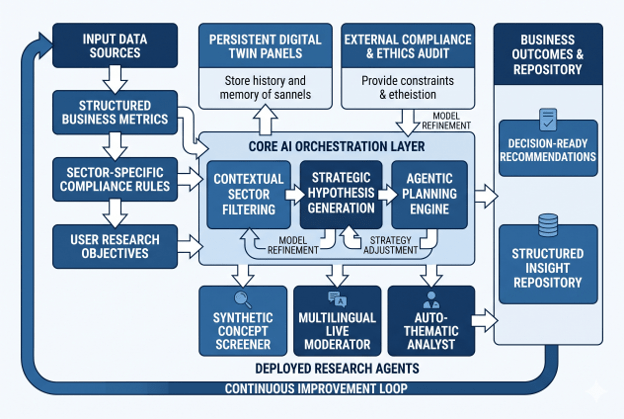
Rather than generating new synthetic personas for each study, organizations will maintain persistent digital twin consumer panels that accumulate knowledge over time; returning to the “same” synthetic consumer six months later and running a follow-up study that references previous interactions. This creates longitudinal research continuity at synthetic research economics.
Development 3: Agentic Research Orchestration
AI research agents that autonomously design, launch, and analyze research studies based on strategic business questions; without requiring human involvement in the operational workflow, are already in early deployment. By 2028, the question “what should we research this month?” will be answered by an AI agent that monitors business performance metrics and consumer signal changes and proactively identifies research priorities.
Section 11: Getting Started — Your First AI Focus Group This Week
The path from reading this guide to running your first AI focus group is shorter than most teams expect. Here is the fastest route to a first study.
Day 1 (2 hours): Write Your Research Brief
Answer five questions: What decision does this research inform? What do you already know? Who needs to see the findings? What would a “red light” finding look like? What is the decision timeline? Do not move to Day 2 without a specific, answerable research objective.
Day 1 (2 hours): Choose Your Platform
For a first AI-assisted real-participant study, HiVox-in-Q is the recommended starting point for US teams running multilingual research or needing community-based group dynamics. For a first synthetic screening study, Dytto or Sampl offer free or low-cost entry points. For adding AI analysis to your existing sessions, Looppanel starts at $30/month. 👉 Follow the full step-by-step guide to running your first AI focus group
Day 2 (3 hours): Build Your Discussion Guide
Use the six-section template from our step-by-step guide. Every question must connect to the research objective you defined on Day 1. Total session time: 60–75 minutes maximum.
Days 3–5: Launch Recruitment and Configure Session
If using a platform with built-in recruitment, configure your participant profile and launch. If recruiting from your own database, identify 30–50 people who meet your participant criteria and send invitations.
Days 6–9: Run Session and Receive AI Analysis
Monitor the live session for high-signal moments. Review AI-generated output on Day 8. Spend 3–4 hours validating the most important findings against raw transcript excerpts.
Day 9–10: Deliver Findings Brief
Structure the output as decision-ready recommendations, not observational summaries. Every finding maps to a specific action the recipient will or will not take.
Total elapsed time: 9–10 days. Total cost: $4,000–$8,000 for a standard entry program.
H-in-Q’s HiVox-in-Q platform is the community AI focus group layer that powers this workflow for US brands; authentic real-participant research at AI scale, with native multilingual support for the full diversity of US consumer audiences.
FAQ: The Ultimate AI Focus Groups Guide
What is an AI-powered focus group?
An AI-powered focus group is a market research method where artificial intelligence handles moderation, analysis, or participant simulation; either facilitating real-participant discussions or generating synthetic personas to predict consumer responses. AI-powered focus groups cost 60–80% less than traditional sessions, deliver findings in 24–48 hours, and eliminate the four structural biases; groupthink, moderator influence, social desirability, and dominant-voice distortion, that reduce traditional research quality.
Are AI focus groups worth it for US businesses?
Yes, for the majority of common research objectives. AI focus groups deliver 85–92% accuracy correlation with traditional methods for concept testing, messaging, and positioning research. A complete AI program costs $8,000–$15,000 versus $45,000–$85,000 for a traditional equivalent, with first-project ROI typically exceeding $22,000 in combined vendor savings and researcher time.
What is the best AI focus group platform in 2026?
The best platform depends on your research objective. For community-based real-participant sessions with multilingual support, Hivox-in-Q leads for US teams. For large-scale live engagement (50–1,000 participants), Remesh is the strongest option. For synthetic concept screening, Dytto and Sampl offer fast, low-cost studies. For AI analysis of existing recordings, Looppanel starts at $30/month and BTInsights is the strongest for source-attributed enterprise analysis.
How long does an AI focus group take?
AI-assisted real-participant sessions take 24–48 hours for the session itself, with a total elapsed time of 9–14 days from brief to findings. Synthetic persona studies take 3–6 hours. Traditional focus groups take 4–8 weeks for equivalent scope. The timeline assumes a clear research brief; vague objectives add 2–4 days.
What are the biggest advantages of AI focus groups over traditional?
Six advantages are consistent across every well-run AI focus group program: 60–80% cost reduction, 80–82% timeline compression, elimination of groupthink and moderator bias, scale to hundreds of participants without quality degradation, global geographic reach without logistical overhead, and the ability to run research continuously rather than episodically, compounding the insight advantage over competitors running quarterly traditional programs.
When do traditional focus groups still outperform AI?
Traditional focus groups retain a clear advantage in four specific scenarios: research requiring physical product interaction (taste, touch, fit), research where observing consumer social influence dynamics is the objective, high-stakes decisions where stakeholder observation of live consumer reactions builds organizational conviction, and research on genuinely unprecedented product categories where AI has no historical behavioral data to extrapolate from.
Conclusion
AI-powered focus groups represent the most significant structural change in qualitative consumer research in 60 years. The economics, the methodology, the bias profile, the geographic reach, and the competitive dynamics of consumer insight have all changed simultaneously — and the change is permanent.
The question for US marketing and research teams in 2026 is not whether to adopt AI focus groups; the accuracy evidence, cost evidence, and adoption data all point in the same direction. The question is how to adopt them rigorously: with proper category selection, validated methodology, human-in-the-loop quality controls, and an organizational model that moves from episodic to continuous research.
The teams that get this right in 2026 will have a compounding consumer intelligence advantage by 2027 that competitors cannot close by budget alone. H-in-Q’s market research suite; anchored by HiVox-in-Q’s community AI focus groups, extended by Converse-in-Q’s conversational surveys and BuzzPulse-in-Q’s social intelligence; is built for exactly this integrated, continuous research model. Every capability in this guide is available to US brands through a single research partner with native MENA and multilingual infrastructure. Start building your AI research capability today →
The brands winning on consumer insight in 2027 are building the capability now.