

The New Battleground for Customer Experience
In the digital age, companies no longer compete merely on products or price, they engage in a race for superior customer journeys. The evolution of journey mapping into what critics call “Journey Mapping 2.0” signals a paradigm shift: customer path‑tracking is now powered by data, AI and real-time feedback loops rather than sticky notes, static diagrams, or gut‑feel assumptions. This transformation forces one question: does this new, hyper‑optimized model actually improve customer experience, or does it strip away human intuition and emotional nuance? The debate pits the precision of algorithms and predictive analytics world against the empathy and subtlety of human judgment. This article argues that the future of customer experience must belong to AI-enhanced design not as a replacement for humanity, but as a necessary evolution that merges data-driven efficiency with human empathy to deliver results at scale.
Journey Mapping 2.0 Is a Real‑Time Engine
From Linear Diagrams to Dynamic Systems
Traditional journey mapping framed customer experience as a linear sequence: awareness, consideration, purchase, loyalty. That model assumed stable behaviors and broad segments. Now Journey Mapping 2.0 abandons simplistic pipelines. Every click, scroll, interaction (online or offline) feeds into a dynamic system driven by data flows. What was once a static picture becomes a living machine, continuously updated to reflect each customer’s evolving context and preferences. The result: far greater granularity and relevance than any human-led mapping could ever deliver.
Customer Experience Powered by AI Feedback Loops
Behind the scenes: machine‑learning models ingest behavioral data, segment customers in real time, and adjust journeys on the fly. If a user abandons a cart, the system might trigger a personalized email; if they browse but don’t purchase, a tailored offer could follow. This constant feedback loop ensures that companies respond to needs before customers even articulate them. Businesses adopting such systems report improvements including lower costs per interaction and higher conversion rates because every touchpoint becomes optimized. A dynamic engine replaces static guesses.
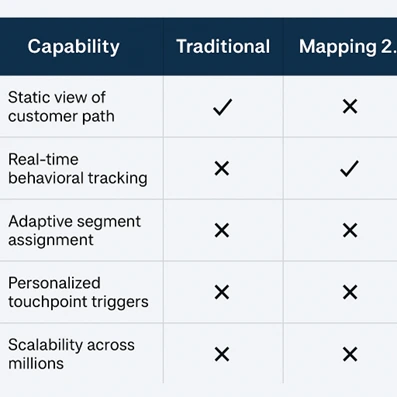
Traditional vs Journey Mapping 2.0 Capabilities
Predictive Analytics World: Intelligence or Illusion?
Forecasting Behavior in an Unpredictable Market
Predictive analytics world today leverages machine‑learning models to forecast customer behavior. Firms analyze purchase history, browsing patterns, demographics, and real‑time signals to anticipate next moves. The result: pre‑emptive outreach, timely offers, and frictionless experiences that feel “on cue.” Businesses leveraging predictive models show concrete gains: satisfaction metrics climb, churn drops, and lifetime value rises. This forecasting becomes the backbone of modern customer experience strategies.
Signal vs Noise: When Data Misleads
But predictive power isn’t infallible. Markets shift, preferences change, and human behavior often defies patterns. Over-relying on predictive models risks misinterpreting noise as signal triggering irrelevant nudges, intrusive content, or misaligned offers. Decision fatigue, over-automation and inaccurate predictions can degrade the very experience companies aim to improve. The notion that predictive analytics world always “knows best” is an illusion that can backfire.
Predictive Analytics in Customer Experience: Opportunities vs Pitfalls
| Use Case / Benefit | Opportunity (What Works) | Pitfall (What Fails) |
| Predicting churn risk & enabling retention | Reduces churn; personalizes outreach ahead of problems | False positives : targeting loyal customers unnecessarily |
| Personalized product recommendations | Boosts conversion, cross-sell, upsell | Irrelevant suggestions erode trust |
| Real‑time segmentation & dynamic content | Highly relevant content for users | Privacy backlash, data fatigue |
| Campaign optimization | Efficient spend, better ROI | Over‑optimization leads to homogenized experiences |
| Automated lifecycle triggers (onboarding, win‑back) | Timely and relevant engagements | Robotic interactions feel inauthentic |

Personalization in Marketing: The Age of Algorithmic Intimacy
Hyper‑Relevance as a Competitive Advantage
In marketplaces saturated with noise, personalization in marketing offers a lifeline. By tailoring content, product recommendations, emails and even website layout to individual profiles, companies deliver a sense of one‑to‑one attention at scale. Studies show AI‑driven personalization significantly increases engagement, brand loyalty, and conversion because consumers receive what matters to them. Hyper-relevance is no longer optional; it is the baseline of effective marketing. (ResearchGate)
The Thin Line Between Personalization and Creepiness
But personalization harbors danger: what feels like insight can cross into intrusion. Overly aggressive targeting, too‑precise recommendations, or reminders of abandoned carts can trigger distrust. Consumers often sense when algorithms know “too much.” Excessive use of personalization can degrade customer experience, turning personalization into pressure. Navigating this fine line demands transparency, restraint, and respect for user privacy.
5 Key Personalization Techniques Transforming Customer Experience:
- Real‑time content adaptation (websites, apps)
- Personalized email sequences based on user behavior
- AI-driven recommendation engines (products, content)
- Dynamic lifecycle marketing (onboarding, re‑engagement)
- Predictive churn & retention triggers
Human Intuition in CX: Disrupted or Rebooted?
Emotional Intelligence vs Pattern Recognition
Human intuition brings understanding of emotion, context, and nuance like empathy, subtle cues, tone, cultural sensibility. AI handles scale, data patterns, speed, but lacks genuine feeling. Can an algorithm detect the guilt, pride, joy, hesitation of a customer? Not really. Emotional intelligence remains uniquely human. If companies abandon human-led CX design entirely, they risk flattening the experience into cold, data‑driven flows. Humans perceive subtle cues that no algorithm can, urgency in a message, frustration in a call tone, nuanced feedback in open text. Intuition still matters.
Designing for Feeling in a Quantified World
That said, human intuition cannot operate at scale or respond in real time to millions of customers. The future of customer experience must be a hybrid: data-driven systems enriched with human insight. Emotionally intelligent frameworks set the tone; AI executes at scale. Design teams should craft empathy-informed rules, while AI handles segmentation, triggers, and real-time optimization. The result: efficient, personalized experience guided by human values.
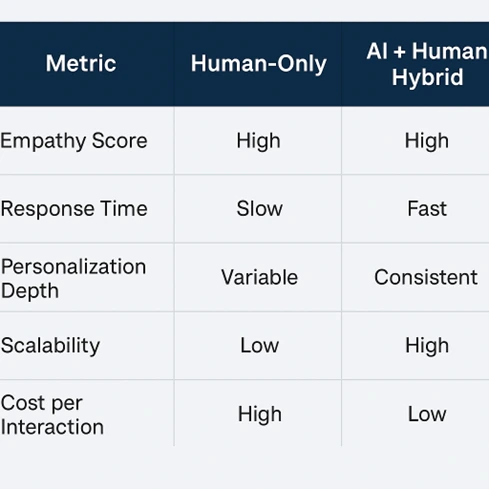
Intuition vs AI: Emotional Impact Metrics in Customer Experience
Data Ethics and Customer Experience: Who Draws the Line?
The Surveillance vs Service Dilemma
With vast data powering every touchpoint, companies walk a razor’s edge between service and surveillance. Tracking browsing, purchase history, social signals: beneficial for personalization but risky for user privacy. Over-collection can feel invasive. Without proper governance, predictive analytics world becomes creepily predictive, crossing ethical boundaries. Transparent data practices are essential. When consumers feel tracked, experience degrades trust erodes.
Trust as the New Customer Experience Currency
In a data-driven world, trust becomes the most valuable asset. Transparency on what data is collected, how it’s used, and giving customers control over their data, these are not optional extras. Ethical data practices build loyalty; shady data tactics destroy it. According to recent analyses, organizations that integrate ethical AI principles see higher long-term engagement and better brand perception. (virtusinterpress.org) The real differentiator isn’t just the smoothness of the journey but it is the customer’s confidence that brands respect their autonomy and privacy.
Ethical Data Use Factors That Influence Customer Experience Trust
| Ethical Factor | Impact on Trust & Loyalty | Risk if Ignored |
| Transparent data collection policies | Builds respect and clarity | Suspicion, churn, brand damage |
| Opt-in / consent mechanisms | Empowers user control | Perceived manipulation, distrust |
| Minimal necessary data use | Lowers intrusion | Data breach risk, reputational harm |
| Clear data‑use explanation & value | Increases perceived fairness | Users feel exploited |
| Ability to withdraw / delete data | Reinforces autonomy | Users feel trapped or exploited |
The Business Case for AI in Customer Experience
From Cost Center to Growth Lever
Companies investing in AI‑enabled customer experience transformation report tangible improvements: lower service costs, higher conversion rates, increased retention. In fact, firms leveraging AI for journey orchestration what some call “next best experience”, see revenues increase by 5–8%, customer satisfaction rise 15–20%, and cost‑to‑serve drop 20–30%. (McKinsey & Company) These numbers prove that customer experience is a lever for growth, profitability, and competitive advantage. AI turns CX from expense to profit engine.
Proving ROI Beyond Vanity Metrics
Vanity metrics such as clicks, likes, opens, are easy to inflate. Real ROI comes from retention, lifetime value, reduced churn, and incremental revenue. AI-driven personalization, predictive segmentation, and dynamic journeys help deliver real financial results. Businesses should track metrics such as retention lift, CLTV (customer lifetime value), reduction in support costs, upsell rate, and repeat purchase frequency. These align directly with revenue impact. When tracked correctly, ROI from AI-enabled customer experience becomes undeniable.
5 ROI Metrics That Validate Investment in AI Customer Experience:
- Increase in customer retention rate (%)
- Lift in customer lifetime value (CLTV)
- Reduction in service cost per customer interaction
- Increase in average revenue per user (ARPU)
- Growth in repeat purchase / upsell / cross‑sell rates
Future of Customer Experience: Designers, Data Scientists, or Both?
The End of Creative Silos
The rise of Journey Mapping 2.0 signals the collapse of traditional silos: marketing creatives, data analysts, and customer support no longer operate in isolation. The future demands cross‑functional teams where data scientists translate behavioral signals into actionable marketing moves, while designers ensure emotional resonance. The divide between “creative” and “technical” is dissolving. Customer experience becomes a playground where storytelling, data, and automation merge.
Who Really Owns the Customer Journey Now?
In this new era, ownership shifts. The journey is no longer governed by a marketing manager, but by algorithmic orchestration grounded in data. Data scientists, AI engineers, and analytics experts become core to CX strategy. Brands that embrace this shift will thrive; those that cling to intuition-only models will fall behind. The future belongs to those who master both empathy and analytics.

Human Touch or Algorithmic Precision?
The future of customer experience demands more than nostalgia for empathy or blind faith in automation. The status quo static journey maps, gut‑driven strategies does not scale. The pressure of modern markets, multiplicity of channels, and volume of interactions make human-only models obsolete. Journey Mapping 2.0, powered by predictive analytics world, personalization in marketing, and ethical AI design, offers businesses the only viable path to relevance, efficiency, and growth. This transformation elevates human intuition and embeds it within data-driven systems to create empathic, efficient, and scalable experiences. The verdict is clear: brands that cling to old‑school intuition will wither; those that embrace the synergistic power of human empathy and algorithmic precision will define the next generation of customer experience.
References
- How AI Can Power Every Customer Interaction – McKinsey & Company
- Personalization in Digital Marketing – Enhancing Customer Experience Through AI (ResearchGate)
- Ethical Issues in Predictive Analytics and Customer Data (Virtus Interpress)
- Emotionally Intelligent Machines: Can AI Feel Customers?